I was so determined to go out on the tundra and look for eggs that are being laid by migrating birds that I almost sold my soul! No, I'm joking. I
was indeed a woman on a mission, single-track minded until I got myself a ride on a boat going to a place just inhabited by birds... and it was amazing.
Actually I had several working plans that didn't quite work out. First, we were going to drive north along the beach, away from town, towards the bay north of us, the Kokechik Bay. There are three rivers that flow across the beach out into the sea on the way, and the trick is to hit the rivers at low, low tide so that they are able to be crossed by walking or by Honda. I tried a couple times, but the tide always seemed high to me -- I have a lot of learning to do in that area, tides. So Esther and I always gave up and we went walking in the tundra near the beach, just past the sand dunes. We always had a good time, tramping around, and we saw lots of birds and bird pairs, but we never saw an egg. Zip, zilch, nada, nothing.
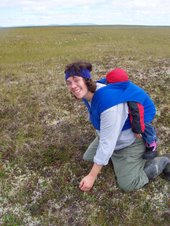
 Esther on the tundra, on one of our tramping days, having lots of fun.
Then we were going to walk Northeast of town, on the tundra, but it ended up being too far that we had to go by walking, as Esther couldn't walk as far as we needed to go and I couldn't carry her
and eggs
and our stuff. Honda riding is illegal past a certain point on the tundra, to preserve the fragile moss, and I have no desire to be illegal and go tearing up the tundra on my 4-wheeler. So that plan was tossed out.
Then I decided I was going to hitch a ride on a boat, any boat, and pay for gas so that I could get an invitation. It took a little pleading from several different parties, but finally my old buddy Tul'uq took me out across the bay into a river towards the Chevak side of the tundra. He came up to my classroom around 1:25 pm on last Thursday and said, in such a typical Yup'ik way, "I'm going to take my boat out around 2, maybe check my net, check around." Even though my western social senses told me not to be rude and assume it was an invitation and not to invite myself, I knew that in a Yup'ik way, it was totally an invitation, and I need to jump on this opportunity. So I said, hey, I wanna go, do you need some gas? I can get some gas on the way?And he said "yeah but I'm going at 2".
I jumped into action. Since it's the end of the year and there are so few students here, my principal was great about letting me leave with short notice on a half a personal day, and I easily found another teacher to watch the 5 students I had. I called Roy for a ride and to make sure he would be OK watching Esther baby for another couple hours, ran home and grabbed my stuff, and pretty soon I was at the dock ready to go.
It was the first time I've ever really left Esther alone with Roy and not been basically within shouting distance. He's been great for a few months now, so I felt pretty good about it, but still a little nerve-wracking, and I think it would have been if I were leaving her with anyone, really, and going so far away from her that it would be hard for me to get back to her quickly. I had a VHF radio, so I could be in contact if I needed to be, but, still -- and I know I haven't left her barely at all in her life so far, especially compared to other mothers -- I haven't even spent a night away from her in her life! So I felt it was Ok to go, OK to expand the boundaries of going off and doing something by myself without her. Oh, and I wasn't quite comfortable with taking her in a boat, yet, since the lifejacket situation is slightly sketchy and I don't think she has the concept of what might happen if she climbed out of a boat or something like that. So, anyway, I was slightly trepidatious, but also very excited to go, and I felt really good and secure about leaving her this time. She was happy when I left, no tears or wanting me to stay -- she cheerily waved me off, saying, "You go by boat, mom? You will?" :)

I forget how wide open the bay is. We skimmed along for 20 minutes on smooth, deep blue water before I saw the other shore, and I didn't even think that we were still in the bay; I thought we must have gone out into the ocean and were going to some island. But then Tul'uq pointed out a barge near Chevak, and I realized where we were. I asked him, "what's this place called?" and he said, "Qalluvik, like "snowpants"". :) We entered a river on the other side of the bay, and flew along the mirror-like waters until we saw a bird along the edge of the bank fly up, and we swooshed to a stop and put the boat up onto the muddy bank.
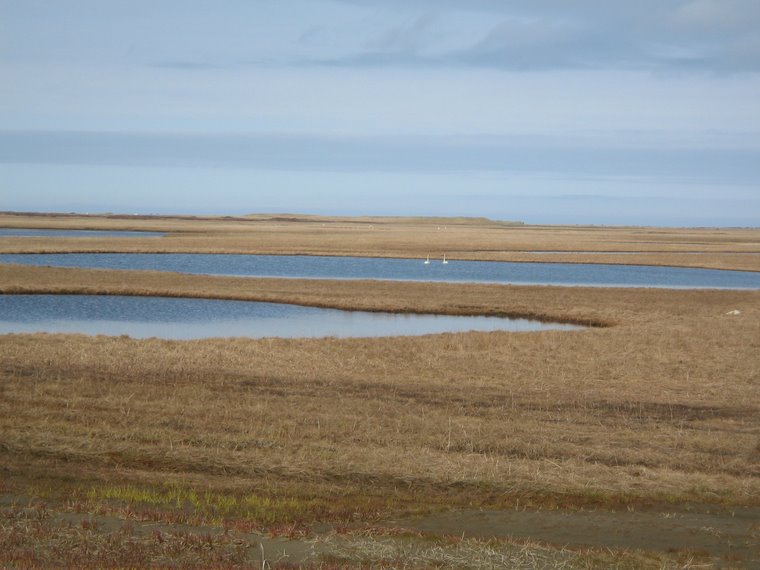
The tide was fairly low, so when we stood in the boat, just our heads were above the bank. The tundra was flat and just went on forever, as far as the eye could see, little grassy areas and grassy humps, broken up by stretches of muddy flats. It looks kind of bland, even in my pictures, and so it's hard to convey what an amazing environment it is to explore. The earth is spongy and fresh-smelling, and the mud is even neat. It's got so many different colors in it, and it has the consistency of jello, when the jello is almost done. Then sometimes, in some of these mud flats, there was a layer of slippery stuff on top, with the stuff farther below more solid. I found I could skate along, almost ski, through this mud, in my rubber boots. It was so fun, and less tiring than tromping through the mud and sinking in. Then there are the clouds of bugs on the mud, I'm guessing like gnats or no-see-ums, kind of gross but then it makes sense, with all these little birds running around who need to eat.
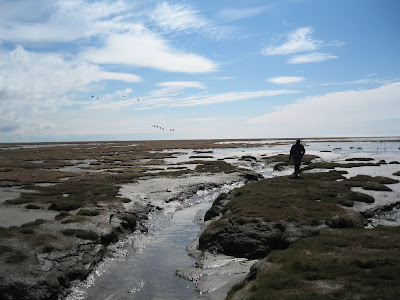 "Qalluvik" -- the tundra where we tramped, with grassy places and mud flats and creeks, and Tul'uq in the distance.
Tul'uq stood up so he could see over the river bank and looked through the binoculars and said, "There's a bird nest up there with one egg in it" and laughed. I got excited anyway, because I've never seen an egg, a nest, or a bird on a nest, nothing. I knew from talking to people that you would be able to find eggs by watching for birds to fly up from the ground as you walked along the tundra, and by going where they flew, you would find eggs.
 The first Egg I found. You can judge its size against my hand, though I do have fairly large hands.

But I had a completely different picture in my mind of how a bird would sit on the nest. I was thinking chicken, you know, because I have had chickens and seen them sit on their eggs, even for a little while, all sitting up and stuff. But tundra birds are so smart! They totally hunker down over their nests, stretching their necks out along the ground to camoflague themselves. You'd think that I would be able to see the birds as I walked along, especially since the tundra is not even full of tall grass right now -- the grass is brown and still pushed down from the snow being on top of it for so long. However, I never once saw a bird on a nest when I was walking along, not until they flew up. I only saw the one through the binoculars that first time, and then a couple, later, who had nests along the bank and I watched them hunker down and stretch their necks out as we drove by in the boat.
In fact, Tul'uq was totally laughing at me because I walked by so many nests with eggs in them. He wondered how I could miss so many! I have no idea, because I thought I was looking! But I felt like I started to get better at it as the day went by. But anyway, the nests were AWESOME. It looks like the birds swirled some grass around, then plucked out some of their warmest down to line the nest. Then they would lay eggs inside that, inside that totally toasty place. Most of the eggs I picked up were still warm! And they were so big -- like two or three chicken eggs at least.
 Here is a lovely warm nest of greenish eggs. I'm not sure what bird laid these, but I left these ones alone in the nest where I found them.
 I tried to figure out which nests to leave alone -- The Fish & Wildlife department published a booklet about which eggs to pick up and which to leave alone, and sometimes I could do it and sometimes it was difficult(by the way, that same booklet legitimized my ability to gather eggs: egg gathering is open to any permanent resident of the area of Alaska I live in, and by their definitions I am totally a permanent resident. It's different from marine mammals, who are just supposed to be hunted by Alaska Native people, as far as I understand. So I was totally legal.
I asked Tul'uq if we should leave some eggs in the nest for the bird, and he said they just come back and lay more. I know from chickens that they do in fact have lots of eggs to lay, and they lay often, so I inuitively felt OK about this. Plus, as I would walk along, sometimes I would see old footprints going to a nest, and I would see more eggs in the nest -- I mean, it must have been that the footprints were from someone who picked the eggs a few days earlier, and now there were many more eggs in the nest. I guess I had thought, also, that the birds would abandon a nest if it had human scent in it. But it seems like they go back to their nests and just keep laying.


And it's not like there were very many footprints-- just here and there I would see some. It was almost reassuring to see them, though, because at times I felt like I was out at the end of the world. There was no sign of any kind of human habitation for as far as my eye could see, and sometimes I got separated far from Tul'uq, because we were walking in different areas, and as we walked we would have to cross little creeks, and somehow we just got more and more separated. He had put a big pole in the bank with his jacket on it so that we could remember where the boat was anchored, and as soon as I got a little ways away I saw the extreme sense in that, because I would never have figured out where the boat was -- in fact, the jacket seemed to grow exponentially smaller as I got a distance away, and it seemed to hover or float -- a wild optical illusion.
But, essentially, I felt like I was so far away from everything and everybody in the world -- human, that is. I was surrounded with hundreds upon hundreds of birds, all different kinds: tons of different species of geese and ducks, also swans, cranes, and little seabirds like arctic terns and plovers, snipes, sandpipers, seagulls. The birds would notice me and fly up in great flocks, but, honestly I felt like I was insignificant to them, because they had all kinds of drama going on, with big birds swooping down on little birds, and little birds retaliating in groups against loner big birds. It just felt like birds were perfectly adapted to this place of grassy humps and mud flats, like I was in a bird land, or bird world. I almost felt like I was in this discovery channel movie that I had been showing to my students, about scientists' guesses about what the world might be like in 100 million years, when everything is really hot and there are muddy and salty plains all over the place, and there are no humans, just animals. Yeah, it was like that, like I had fast-forwarded through time and I was the only human left in this world of birds.

A small flock of Emperor Geese glide by.
Not that I would have really liked that in reality, but it was a fun feeling to be so out of time and space. I got that wonderful feeling of time just not passing, which the sun helps since it doesn't set till late at night these days, and so it doesn't move much from up in the sky for much of the day. It rained a couple times, and then cleared up, and the sun was very warm. I am positive that I haven't walked as much as I did that day for pretty much all winter, but though I felt tired, I didn't even feel like I needed to stop; I felt like I could keep tramping around forever. I just love that wide expanse of tundra so much, like finally I have enough SPACE. I was totally in my element. I don't even know how long we spent out there.
And then, the eggs, Bonus! I would be surprised every time, when a bird would flap up with a rush of wings and air -- the closest I ever got was around 3 feet away. I actually really wanted to catch one on the nest, before it flew away, to get a picture, but they always surprised me and flew up before I had the chance. And then there would be these gifts, these wonderful HUGE eggs, all warm and lovely, many times in cool colors.

Finally we got back to the boat, had some snacks, and turned the boat to go. The tide was even lower at this point, so we got a little stuck in the sand a few times, even once we were out in the bay. But Tul'uq is such a pro at boat stuff that we were able to get out into the deeper channel again.

We stopped on our side of the bay, very close to Nuvok, to check his net. He put everything back, because he had caught only things he didn't want. But in the interim, I saw that there was a rainbow across the bay -- and the fantastic thing about living on the tundra is that you can see rainbows from start to finish, from end to end. From where I was looking, one end of the rainbow was sitting on the spit of sand that is Nuvok, which is littered with remnants of whale carcasses right now. So my big joke is that I found out what is at the end of the rainbow: a bunch of dead whales!

So after we docked the boat and Roy & Esther picked me up, on the way home with my almost-five-gallon bucket-o-eggs, we saw Esther's great-grandma Bridget standing on her porch, and so the very first thing I did with the eggs was to give a great big colander-full to her, and she was really surprised and happy. It felt great to give her something that I had collected myself.


When I got home, I divided eggs into other little parcels to give away, to Roy's other grandma and his mom, to my friend and classroom aide Norma, to my neighbors, and to another elder who has been helping in my classroom these weeks, Nellie.

Here I am cooking a goose egg and a seagull egg -- the gull egg has the darker yolk.
I kept a bowl aside of some of the rest in the fridge, to use for us the next couple weeks, and I froze the rest. I looked up on the internet how it's totally OK to freeze eggs, and it gave me a couple different methods. People in the village usually just freeze them as is, in the shell, in the freezer. I tried that, and as I expected, they got a crack from the expansion, but they seem ok. Some I tried by putting them in a bowl of water and freezing that whole bowl, and those seem to be fine, though when I thaw them I'll have to use all of those particular ones at once. But the way that I learned on the internet and seems the most user-friendly to me is to crack the eggs, whisk them together, and then pour them into ice-cube trays. When they froze, then I popped them out of the trays and put them into a ziplock, so I have perfect serving-sized eggs to use for later.

Here is the production line: crack & mix them, pour them into ice cube trays.
I think I am having success in raising Esther to be a good Yup'ik eater, because as I was cracking the eggs to mix & freeze, a couple times I came upon an egg with a bird embryo that was pretty developed. I called her to me to show her the baby bird. Her immediate reaction was to say, all in a rush, "Ooo! A baby bird I wanna eat it!". Ha! So I cooked them for her, and she munched on her bird embryos and pronounced them "really good, mom!". :)
And, then, cooking them, of course, has been fabulous. Tul'uq found swan eggs yesterday and gave me one -- it was enormous, as you can see! The egg, when I cooked it for breakfast, filled up my entire skillet, and seemed like a large omelet in intself. I can't contain my excitement about all of this... this egg stuff is just too fun!
 Remember, I have large hands, so this egg is enormous!
 From left: a Swan egg, a Sandhill Crane egg, a goose egg, a duck egg, and a chicken egg from the store. Wild, huh?

Cracking this egg I had a flash of memory of the cartoon "The Flintstones", when Wilma would crack a dinosaur egg? yeah, it was just like that. :) This is a 10 inch skillet.
 This was my plan: as soon as we had finished school on last Saturday, I was going to go out onto the tundra. I had a lot to accomplish: #1 set up a campsite, #2 set out my fish net, and #3 build a rack to dry the fish on. I have never done #2 or #3 before --though I've accummulated a bunch of advice over the months. I was just going to do it by trial and error, and by watching what other people did, and if I messed up, then I'd learn from my mistakes.
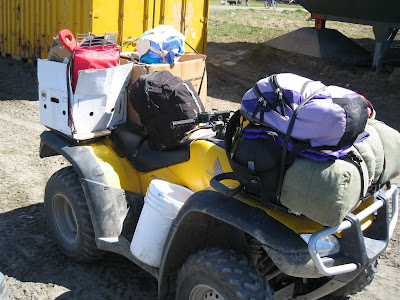 got out onto the tundra and realized: What's the rush? I've been on this schedule, getting things done, for so long, and now I have all these routine-free days stretching out ahead of me. Can't I forget the mission-mindedness and take it easy for a while? So I just set up the campsite, got a fire going, and explored for a while. Esther and Odin seemed to like this goal just fine. We saw a red fox from a distance, the first fox Esther has ever seen, and it trotted away from us and we didn't see it again. I stained the knees of my pants blue and red from last year's cranberries and blackberries (that were under the snow all winter, and now are all over the tundra, but watery and fermented) trying to find the softest mossiest place to put the tent -- I found a pretty awesome spot:
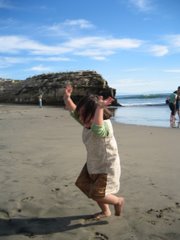
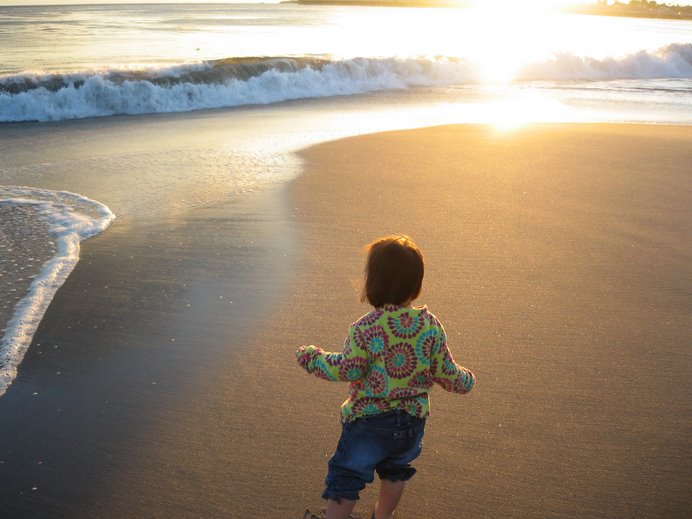
 Our spot is on a penninsula between the Bering Sea and Hooper Bay -- in the distance in the above picture, you can see the bay. The ocean is a couple hills behind me in this picture, close enough that we went to sleep lulled by the sound of waves crashing on the beach every night, and close enough for Esther to go play on the beach in the sand every day, often with other kids who are out playing on the beach with their families:
 Later that first evening, teacher-friends Katie, Moses, and Marta joined us (along with their dogs Honey & Tika), and besides being awesome weather, it was a cool night because we walked a little ways away to Old Hooper Bay, one of the old village sites and checked out the remnants of sod houses that once were there.


 Our spot is on a penninsula between the Bering Sea and Hooper Bay -- in the distance in the above picture, you can see the bay. The ocean is a couple hills behind me in this picture, close enough that we went to sleep lulled by the sound of waves crashing on the beach every night, and close enough for Esther to go play on the beach in the sand every day, often with other kids who are out playing on the beach with their families:


 We sleep so well outside, too, though we often wake up early since it gets bright very early, as the sunrise is around 3 (though since the sun sets around 1, it just is dusky all the time; no night). The next thing I knew it was warm morning in the tent and Esther was saying, "Mom, a snipe did wake me up!" Super cute.
  Poor Mosquito-bitten babe! I missed a spot on her forehead when I was using citronella oil on her, and the mosquitos all went to that particular spot. :( In general, though, the mosquitos aren't very bad since there is almost a constant wind, with no trees to block it. The days that the wind lets up are the days when the mosquitos come out, but that's not very often. I wonder: what do the mosquitos do for all those windy stretches of time? How do they eat? Why wouldn't they all just die out? I bet the mice and other animals in the grass are just one huge mosquito bite.
 My campsite has gotten fancier over the days; Roy decided to join us for a night and we built a lean-to to put my supplies in, and as an additional windbreak, since it is pretty windy out there, even though it's beautiful. We had a bit of rain this morning, but nothing that was unpleasant. We've been having some fantastic meals out there -- even though it's normal food, cooking it over the campfire somehow makes it amazing....
  Now we've slept out there four nights, and we plan to just keep going for a week or 10 days; Esther and I go to my mom's house on June 25. This is one of the best things about living here, that the wilderness is off my back doorstep, and even though I can even see my house from my campsite, way off in the distance, I am in a totally wild place. We often come back to the house for supplies and showers, etc., (and to blog!), and then we just turn around and go right back out -- it's a 20 minute drive, tops. Awesome.
 Esther by our lean-to, the Tibetan peace flags waving in the breeze....


 Then we began to get seal given to us from Roy's mom, and Roy's aunt Emily, the aunt Emily who often takes care of Esther. Emily and Melba (Roy's mom) would get called by other families who had hunted and caught seal to help with the butchering of the seals, and they would be given large parts of the seal in return. They in turn shared it with me, for which I was very grateful. At one point, Roy's mom was given a whole small seal, and her freezer was already full, so she gave it to us, the whole thing, minus the skin. For the first time, I had seal blubber, also, called "Uuquq", which traditionally is rendered down into oil, and then the oil is used for seasoning soups and fish, and dried salmon is cured inside it to make something called pokefish. I decided to try my hand at it:

 Here are the guys doing the huge work of helping put the whale into the hunters' boat.
 In this picture you can see how the blubber is a layer in itself outside of the meat, and the first step is separating those two layers.


 Hunters who have caught two beluga whales.


 My bowl of clam and whale skin chowder -- you can see the grey chunk of skin and a couple clam feet on top of the soup.


 Posts
Posts