Tuesday, June 5, 2007

Fruits of the Ocean (aka Sea Life Extravaganza)

The wave of foods from the ocean began in March, with the arrival of pike and smelt, which folks gathered via ice fishing. Since we don't have a snowmobile, we didn't go, since it was kind of far away to go by Honda. But we got given some very tasty smelt, and to my surprise, some huge ones! Maybe my midwestern buddies remember smelting on Lake Michigan, and how teeny those little fish were; these smelt were actually a decent-sized fish. And yummy. Here is a picture of Roy preparing them for baking while Esther looks on:

Soon, people in the village began seal hunting, and we had our first fresh seal of the year at Roy's mom's house. Seal meat is one of my favorite things in the world -- I have this irrational craving for it; it definitely has a strong taste, but it is very tender and very filling. When I eat it I feel like I could never eat anything else again, it's that satisfying. It's wild, like it satisfies a craving all the way down to my bones, or something -- maybe it's because it's so rich in nutrients like iron and omega-3s, etc, that my body knows it's fulfilling those nutrient-needs. I don't know, but I know I like it! Here is a picture of Esther and her cousin Sheila enjoying their seal:
Then we began to get seal given to us from Roy's mom, and Roy's aunt Emily, the aunt Emily who often takes care of Esther. Emily and Melba (Roy's mom) would get called by other families who had hunted and caught seal to help with the butchering of the seals, and they would be given large parts of the seal in return. They in turn shared it with me, for which I was very grateful. At one point, Roy's mom was given a whole small seal, and her freezer was already full, so she gave it to us, the whole thing, minus the skin. For the first time, I had seal blubber, also, called "Uuquq", which traditionally is rendered down into oil, and then the oil is used for seasoning soups and fish, and dried salmon is cured inside it to make something called pokefish. I decided to try my hand at it:
Here is my workspace on the floor, with the bucket of blubber and my traditional knife, called a "Kinaluq" out here on the coast, opposed to the inland, "Ulu". It has a very strong smell, perhaps some westerners would find it offensive, but I have gotten used to it and enjoy it.


Here are some of my jars of Seal Oil, Uuquq, when they are about done rendering. Only the jars in the front -- the ones in the back are my store of water jars, for when the water goes out,as it is bound to do up here!

Rendering the oil is a simple process --you cut the blubber into strips, score the surface of it for better oozing, and let it sit for a couple weeks. Then you are left with little fatty remnants that you take out of the jars. Some people use those strips of fat for food, in soup, or whatever, but I think I'll use them to start my campfires this summer instead of using some kind of petroleum-based fire starter.

As I was rendering this blubber down, I got lots of different advice from various sources, and some that I considered superstitious, but as with all supersitions, they must have their root in something practical. For example, I had them originally up high on a shelf in my pantry, and I was told they needed to be down low or they would be sour. I was told they needed to be in the dark, in the cold -- both of which makes sense. I was told that only certain containers, and certain colors of containers, all of which was interesting to me. My uuquq has turned out Ok so far, except for the jars that grew mold -- eew! Which I got rid of. I know how it happened, too: being a good, clean-obsessed westerner, I washed some parts of the blubber that seemed dirty to me. Guess which jars molded? The ones that I had washed. So interesting.


And we were given yet another seal, under interesting circumstances. Several teachers and I went out to the beach one Saturday evening to see hunters who had caught whales (I'll describe this adventure at the end), and we encountered some out-of-town hunters who were having difficulty getting a whale they had caught into their boat. The guys from our party helped the hunters, and in return they gave us a whole seal, for thanks.
Here are the guys doing the huge work of helping put the whale into the hunters' boat.

We had an adventure figuring how to butcher the seal best, and how to separate the blubber from the skin and meat. There were six of us working on this little seal, a spotted seal. It took us a long time and lots of trial and error to get it right -- I was the only one who had worked on one before, and that was only once. We flagged down a few students to help us, who were quite adept at it, but all of our other calls we made out to people we knew might could help went unanswered -- everyone was out, away from home on a beautiful, sunny evening. So we muddled through as best we could, and enjoyed ourselves a ton.
I know my eyes are closed in this picture, but I was tired! No, I joke -- I like it anyway because it shows how many people were working on this seal at once in my kitchen -- teacher Audrey is to my right, and her husband Mike's hand is reaching in at the forefront of the picture.


In this picture you can see how the blubber is a layer in itself outside of the meat, and the first step is separating those two layers.

The next sea-life adventure was clam-digging, on such a sunny day that I actually got a sunburn, in late May. We went out to the point, the spit of sand that reaches out into where the bay and the Bering Sea meet, called "Nuvok"(and I think I have pictures of this place at winter time, as well, in previous posts) at really low tide. It was very muddy out there, very sloppy, but we found an enormous cache of clams, and really big ones!

It was a gorgeous day at Nuvok, low tide, with the mountains very clear in the background. There were a bunch of clam diggers out there that day.


Esther is holding a little clam she helped me dig up, its foot out.
It is so fun to dig them up, because they spout water out of their little foot as you hoist them and the mud they're in up with a shovel. It was totally addictive to dig these clams and only a tired, muddy, wet, cold baby could make us quit.

She was so muddy that it looked like she could be all decorated for some kind of primal celebration! :)


After I got her cleaned up, she totally zonked on the honda, as we gathered our stuff and packed up. :)


Some of our haul of Clams -- steamed up wonderfully.
So the next portion of our adventure might be the most offensive for those of you who aren't sure you're OK with sea-mammal stuff, because I'm going to write and post pictures about whale hunting and butchering, etc. Just to give you warning, just in case!
The whales in question are Beluga whales, the small white and grey whales (small by whale standards), and they come to the waters around Hooper Bay to feed on fish like salmon and herring (herring is what they are after right now) - - they are toothed whales, not baleen. And, while I have lots of romantic pictures of whales, and I feel that they are really magical and wonderful, I also feel OK about them being food. Especially since Esther and I caught a glimpse of the entire pod of whales when they were swimming close to the beach, parallel to shore -- and there were just a ton of whales. I mean, at least 200, maybe more. They just kept coming! It was amazing, because I've never seen whales in the wild before, alive. We were on the beach and I heard this lowing kind of sound, like a foghorn, and I got to wondering what that was, and when I got the binoculars out, I saw them, swimming and diving, flukes in the air and all. Esther couldn't really tell what they were, and was a little tickled by all my excitement. I told her to keep watching out there, because one of them might jump, and she started to holler, "Jump! Jump!". Hee hee.

Here is a picture of the pod of beluga whales, courtesy of Teacher/Photographer Sabrina Silvernale.

It was awesome. And when I saw the pod, I knew there would be hunters catching whales, also, so Esther and I drove down to Nuvok, the point, where I knew they would be, and sure enough they were there. I was glad I had brought buckets, to bring back meat and skin -- most of the time it is just fine to go where hunters are butchering the whales and to ask if you can have some of the whale, since they are so big. Roy expertly cut some off for us, and then I tried my hand at it, much less expertly. It was a really different feeling than butchering the seal because the whale, though dead, was still warm -- and to cut off some of that was just a little overwhelming. But, still, there was an emotional line between what I had seen swimming in the ocean and what was here, on the beach, being butchered.

Hunters who have caught two beluga whales.


Roy and another hunter butchering a whale.


Me trying my hand at cutting some whale meat, with teacher-friend Melody and the hunter, Leonard Bell.

So now I had this big load of whale meat and skin, and what to do? Yeah, this is where the real work began.

First I had to deal with the skin -- it is a real delicacy here in Hooper Bay, and I have to admit I liked it a lot. The first time we had some, I tried it raw, and it was very chewy, very buttery. Esther LOVED it raw, and kept demanding more, but we suddenly had a call from Roy's mom to tell us that if we were eating whale, we couldn't eat anything else that evening that came from the land, including the goose we had going in the crockpot. The belief is that if you eat a land animal and a sea animal, you will get indigestion because they will fight in your stomach. However, since that time, I have had multiple discussions with people on this topic, and they say that they won't eat moose and whale together, but they'll eat whale with potatoes, or crackers, or even pop or candy. As my good friend Norma said, "Pop and candy are from the land!". So, anyway, I'm not going to flout this superstition, but I'm going to slowly, cautiously, probe the boundaries of it over time. :)

Preparing whale skin -- cutting fat off, cutting into pieces for freezing.
So, anyway, The preferred way to cook it is to boil/simmer it for a couple hours, until it is very soft, and to eat it with tamari sauce. It was excellent! However, I ate too much of the fat with it -- at first I thought I was feeling ill because of the superstition, but then it just began to be clear when it just felt like I had eaten something overly rich. Roy had told me to cut off the fat after I cooked it, and I did cut off a lot of it, but it was very tasty, and I was thinking it was full of healthy sea-mammal fatty acids(if they had survived the boiling), so I ate it. Mistake! But I was OK the next morning.
The next time I cooked it, I cooked the clams the same day -- I cooked them each separately, and then I made a super-yummy clam chowder and added the fat-free whale skin. Wow! What a great recipe, totally unique to Hooper Bay. :)
My bowl of clam and whale skin chowder -- you can see the grey chunk of skin and a couple clam feet on top of the soup.
The whale meat was a whole 'nother project. I had nearly two buckets of it! One bucket I cut into nice portions and put them in ziplocks in the freezer. I cut a portion of stew-meat chunks and made my mom's beef stew recipe. I browned the meat with onions in a skillet, and then I put it in the crockpot with potatoes, carrots, peas, and tomato sauce, with some spices. It turned out remarkably like the beef stew of my childhood! It was really good, and the meat was very tender. However, I learned I should have washed the meat more thoroughly, because there was some sand in some of the pieces of meat! yikes. It was chew-chew-crunch! The only one who didn't mind was Esther, who still eats sand at the beach anyway. :)

The second bucket of whale meat I cut into nice strips and marinated overnight with salt and tamari sauce.
Then Roy tied them onto strings, and we hung them to dry on his mom's drying rack. Now we just wait until they've dried, to put away for the summer and next year.


Thoughts on a Subsistence Lifestyle -- How I justify and rationalize hunting

So it has been such an amazing spring in regards to reaping the bounty of the sea. Since I began living here, I have wanted to feel more connected to the ocean and the subsistence activities connected with it, and finally I feel like I have my finger on the pulse. I know that people who have not lived here in Alaska often feel squeamish and sad about the hunting of sea mammals, and I respect that -- I don't expect everyone to want to hunt or eat seals & whales because they read my blog. I want to share my experiences doing this because it is still so amazing to me that this is part of my life, and I am thinking it might feel amazing to many of you, too. I do feel a bit of sadness when I see these animals butchered, but there is also an emotional line that is growing broader within myself -- I am beginning to see them as food, and I don't mean that in any derrogatory way. Some of you may remember that I was a vegetarian for 9 years, for all sorts of reasons, and then when I came to Alaska, I had a personal revelation that a subsistence hunter's relationship and respect for animals is actually closer and more spiritual than a vegetarian's, and although I would never disdain my agrarian roots, it started to feel to me that the hunter/gatherer lifestyle is actually closer to the earth than a farmer's -- especially since the hunter/gatherer spirituality is enmeshed with a kind of reciprocity and gratitude that I have never encountered with agriculture. Not that all hunters out here are perfect or totally in line with the old spirituality, but as much as I can, I try to be. I try to use all the animal that I can, and I try to not be arrogant and expect that we will catch anything -- and, yes, I do feel closer to the animals and to the earth than I did when I was a vegetarian.

And eating this food is very much in alignment with my desire to eat whole foods and organically; although there are toxins found in all wild foods, since those toxins are in the environment, now, the levels are still lower than in processed foods at the grocery store. A research team came from Fairbanks to report on their findings about levels of heavy metals in seals, this spring, and they confirmed that belief, that even with toxins in the environment that get into sea mammals, it is still healthier to eat wild foods.

And an animal that is caught out here in this totally wild land has had an amazing life, a really full life. If I stand still and look around me when I am out in the tundra, on the beach, or in a boat on the bay, I realize how enormous this land is, and how small our (human's) part of it is. It really does feel that if an animal is caught, it must have given itself to the hunter, because how else could anyone have caught it otherwise? There are miles and miles it could have gone, in every direction including up and down, to get away from the hunter. Animals have complete dominion here, and life has flourished in this region for thousands of years partly by the grace of them.

And a whole bunch of hard work. Subsistence life is a whole lot of work -- if I thought farming was a lot of work, well, I guess I don't know which is more work, honestly. But the preparation of subsistence foods is a job in itself, and is just as hard on the physical body as farming is. When I would talk to elders in the past about how they used to live, they would always say, "It was a lot of work", and I guess it just didn't register with me, exactly what they meant. I think there are muscles in the body that are never used until you are trying to deal with a huge carcass of something, and deal with it quickly so that it can be preserved in the best way possible. Hands, arms, shoulders, back, legs, wrists, fingers all get so tired and sore from bending, squatting, sitting, carving, slicing, plucking, etc. As I prepared the subsistence things this spring, I finally had a real physical understanding of what the elders meant. The refrain that would come into mind many times is, "If I didn't have to go to work, I could do....", or "If I wasn't so tired from working all day, I could...", always something further with this wild food than I had done. I wish I could live like people here did, and sometimes still do, with subsistence as their main occupation and way of life -- it's totally a full-time job, and totally fun and rewarding -- especially to open the freezer and see the bounty inside and remember that it got there through hard work and kind gifts from others in the community, not via money and the grocery store (well, except for the purchases of shotgun shells and gas!).

So I felt like this topic needed addressing in my blog, so that you all, if you don't know me and my thoughts on this topic already, would know where I am coming from. I am not a blood-and-guts kind of hunter, I am not an arrogant shoot-everything-in-sight hunter, I am coming from a truly respectful place. I find a lot of enjoyment in the connection I experience between myself and the natural world in living this way. I also feel like I am doing what I can living a healthy lifestyle and helping Esther to grow up connected to her cultural heritage.

Tuesday, May 29, 2007

The birds

The birds began to arrive in mid-April, and that set off an excitement so intense in town that it was almost possible to physically feel it trembling through the town. The birds, even more than warm temperatures, even more than south winds or melting snow, are the heralds of spring. They are the ones that let us know that it is time to switch gears and start thinking about spring activities.

The longer I live here, the more it becomes part of my rhythm, too, that I change my habits and behavior depending on the season. It just feels natural, now, that we yuraq (traditional dance) in the winter, and it would feel a bit off if we danced, now. My body responds to the growing light, as well, and I begin to have so much more energy, so much more desire to get a whole bunch of things done when the light stays for so much of the day (Right now, the sun sets somewhere around 12:30 am and gets light around 3.... as far as I can tell. I'm mostly asleep at those times, so I miss all the dark! It will only get more intense, since we have a month until the solstice). Anyway, I find myself hankering after spring activities, also, wanting to be out on the tundra, wanting to be out on the water. I see waterfowl flying above and I get a taste in my mouth for that rich, fatty skin.... I like that I'm acclimated to living here, not just mentally but in body, too.

So soon after we started seeing little snowbirds flying in flocks around the tundra, the ptarmigans began to go close to town, and when people were ptarmigan hunting, they began to see ducks, geese, and other migrating birds coming back. The ducks and geese are mostly what hunters take, and there are some species that are closed for hunting, but occasionally a hunter will take a swan or a crane, as well.


My favorite shorebirds are the arctic terns, as they are the longest migrators -- I think they fly pole to pole. Their wings are so long, thin, and arched.... they are amazing. They have a double-pointed feather tail, and their cry is so interesting. They say, "Kee-aarrrr", with a really gutteral almost-growl at the end. I also love the snipes (yes, there really are snipes, those of you who are victims of the infamous joke-snipe-hunting), because they fly really high into the air and dive, and the wind over their wings makes a haunting hooting sound. I first heard that sound when I was in Scotland, on a wonderful night at the standing stones called Calanais on the Isle of Lewis, and my friend and traveling companion Tanja and I thought they must be some kind of spirit. Even though I know better, now, I still feel a rush and thrill of other-worldliness when I hear the hooting of the snipes diving.

Snipes swimming on a pond, picking off little waterbugs.

Tundra swallows visited us, as well, for a few sunny days, and roosted all over our porch. They were amazingly brave, not shy of our movements inside the house at all, and Esther could watch and talk to them through the window without them flying away. In fact, one day we opened the door to our porch and there were five of them basking in the sun, and they were so slow to fly away that Esther almost was able to pet one. They are such beautiful black and iridescent blue swallows, sweet birds. Local lore says they bring luck to us when they roost on our house, so I guess we have been blessed with a lot of luck!
Roy went hunting for waterfowl for many days in a row, and he brought home a bunch of birds, mostly white-fronted geese. After my experience last year plucking, I had made a vow to myself that I would pluck the geese the day he brought them home, because they are so much easier to pluck the first day, before the skin starts to hold the feathers fast. I guess before I tried plucking them, I never thought about how much work and skill is involved in plucking and doing a good job of it. Fingertips get sore, and wrist and palm muscles get tired, especially if there are many to do at once. The first night, when Roy brought home 4, I plucked a few and put a few in the freezer whole, on the advice that they will last longer without getting freezer-burned into next year if they are whole. But I wonder what it will be like plucking birds that have been frozen?

After that first night, when I plucked them inside our arctic entryway porch and inhaled a whole bunch of floating down, I decided that the next time, I would pluck them outside. I called around to community people I trust, and asked them if it was considered OK to pluck birds outside, and they said I could do it if I was out a little bit from town and the wind was blowing the feathers away from town. The next time Roy brought home 3 geese, and Esther, fellow-teacher Holly and I started out with the birds in a gunny sack for the side of the school next to the bay. It was a great experience! The tundra is so soft and accommodating to sit on for long periods of time, and the wind blowing the feathers away is great. I found that I had to sit a little cross-ways of the wind, not with my back to the wind, or my body would create an eddy in which the feathers would fly right back into my face! The only downside is that my fingers got cold and therefore tired faster. But I have found that doing the bulk of it at once is a good plan, and then doing the fine, little work of plucking the head, wings, and smaller feathers can be done later, when getting them ready to cook.


Here is my teaching comrade Holly plucking her first goose; we are outside behind the school. The picture below is all the feathers from the geese we plucked that evening, when we were all done.


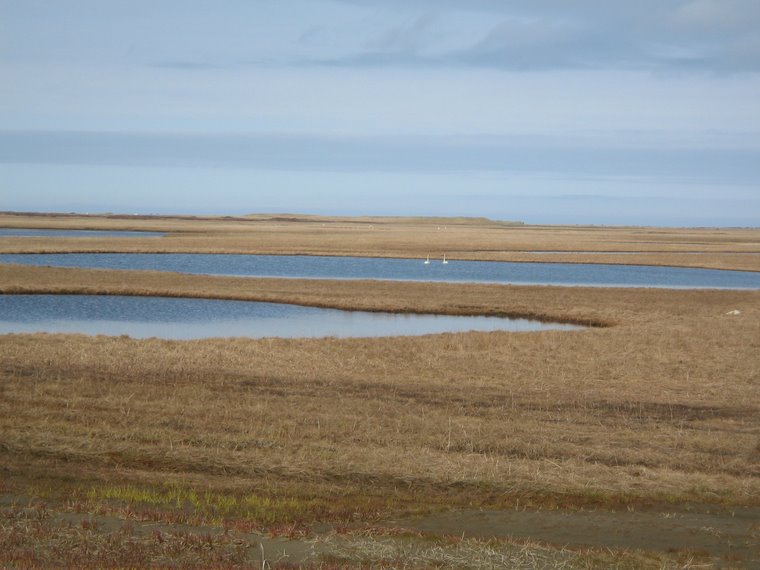
One Friday evening, the night of graduation, I went straight from the ceremony to my favorite bird-plucking spot, and several students came to check me out. They ended up helping me pluck, just for the fun of it, and I was so glad to have their help because it had started to get cold. Mists were rolling in from the ocean, and the air was just heavy with its chill. There were swans swimming, so elegantly, on little ponds near us, and their white feathers stood out even through the mist. It was such a beautiful sight, they were nearly ghost-like, sliding across the ponds through the mist.

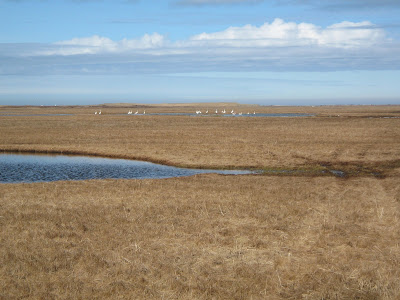
A flock of swans out on the tundra -- they're far away, so even though the picture is little, you can tell how big they are!


When Roy brought home the most birds at one time, 13 in one day(total I think he caught 25 birds this spring), I had a lot of work in front of me. We gave some away to relatives, and then put some in the freezer, but I still needed to work on several that afternoon. It was a sunny Sunday, and Esther wanted to go out with me, so we walked with the birds to behind the school, where the bay is a few hundred yards away. There were several ponds in between the hills where I was sitting and where the bay began, and birds were alighting in the ponds here and there. There was no danger of Esther walking all the way to the bay, but I let her wander and play around near me; there was lots of driftwood for her to climb on, and dirt for her to dig in, etc. A pair of swans alighted in the pond nearest to us, and she noticed them right away. She marched right up to the pond's edge and hollered, "Nice a meet you, swans!". So precious. When I think of what she is possibly missing out of city life, such as swimming lessons or kids' orchestra concerts or some kind of preschool, I feel badly about it, but then I think, "what city child has the chance to experience these things, and to interact so closely with such a wild environment?" and I think it just has to be OK.

Coming soon will be our adventures in egg hunting... I can't wait!

Friday, May 25, 2007

March & April at the Beach


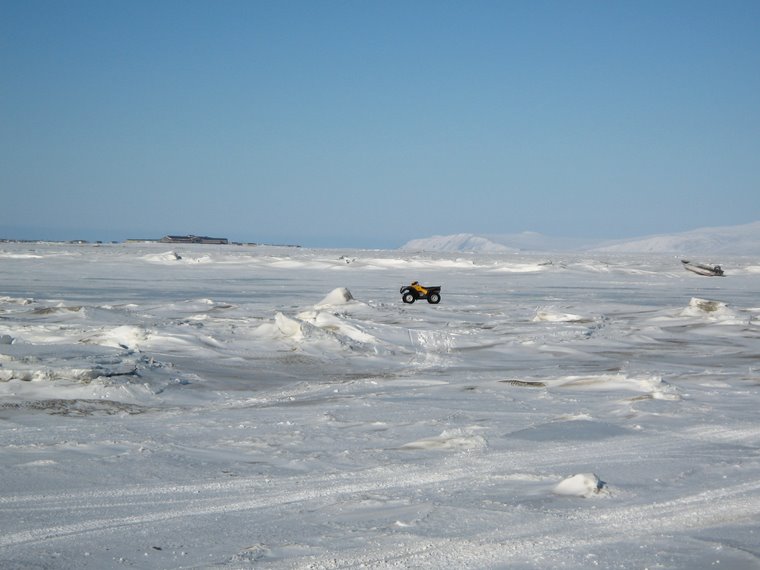
With the addition of a honda to our lifestyle, we have been able to go out to the beach regularly and experience all the changes that it experiences over the spring thaw. The above picture is in early March, when everything was still frozen. We drove out to Nuvok, "The Point" where the beach extends into where Hooper Bay meets the Bering Sea. We saw icebergs frozen in place, and seal hunters out on the edges of the ice. Here Esther, Roy, and Odin Jade (dog) go exploring on the ice, with seal hunters' sleds and snowmobiles in the distance.

Into April, the ice & snow began to thaw, and while it was still chilly, a lot of times still below freezing, there were some wonderfully warm afternoons that melted a whole bunch of winter away. One of the first outings we took to the newly-sandy beach was to sight-in my new .22 rifle (yes, I'm now a gun-owner) I'm going to use for purely subsistence reasons. Here I am learning to sight it in, and then here is another picture of Roy shooting the rifle with his high-school age brother James Jr. looking on:


Pretty soon, we were having cookouts and campfire evenings at the beach. The beach is so amazing because it is never the same any two days you visit it. Sometimes there is nothing washed up except pebbles and seaweed, and other times it's covered with starfish, sometimes a million jellyfish, and then there are the cool finds, such as big bones or carcasses. When the migrating birds started to arrive, the beach was (and is, still) a great place to bird-watch. We have seen lots of ducks and geese, all manner of gulls, some arctic terns, plovers & pipers & snipes, and once we even saw an owl. In fact the owl flew in towards Esther and I while she was playing in the sand and I was building a fire, and it flew in towards us from the water, almost like it was birthed from the waves. It flew towards us and checked us out, hovering over us for a few seconds, and I felt very pierced by its gaze. Then it flew off, so gracefully and powerfully. It wasn't a snowy owl, but a smaller cousin, with a white bowl face, kind of like a barn owl. I'm not sure of the english name for the owl, because people I've asked about it have only known the Yup'ik name, which (forgive my spelling!) is Anipaqsuaq.


We had a great Saturday evening at the beach in April with our friends Marta, Katie & Moses, when we had a campfire cookout, flew my kite in the wind, and saw a rotting walrus carcass. The ice had receded a lot by this time and with the sun on the ocean, it just looked like paradise (what it is to me, that's for sure). Check out all these pictures from that afternoon/evening:


Esther is creating a sculpture of starfish in the sand...


Here's the finished product -- she's very proud.


So proud she'll wear them! :)


Here is the grody walrus carcass. We poked around at it for a while, trying to find out if it still had tusks, but, no luck. :) Stinky!

Thursday, May 24, 2007

The Bladder Festival


So the big culmination of the Yuraq dancing (see previous post for description) is the Bladder Festival in mid-March, often called the Louis Bunyan Festival in recent times. But most people still recognize it as the Bladder Festival, the time of the year when all the bladders of the seals caught during the year, dried and filled with air, are sent back to the sea. Helen Smith, an elder I've been speaking to lately, told me that they used to poke a big hole in the ice and push the whole cache of bladders through, and the bladders would sink without any weight attached. She said the cache of bladders would never re-appear later in the year, never wash up on the beach like many things lost at sea do. They believed this was because the spirits of the seals resided in the bladder, and sending the bladder back to the sea would let those seals hunted and caught be born again into new seals. I don't know if anyone in the village still does this with seals caught in present-day, but it's memorialized with this festival.

During the festival there is lots of Yuraq, traditional dancing, with Hooper Bay groups and visiting village dance groups. I was slightly nervous about dancing with the group, because I knew it was alright that I had practiced with them, but I wasn't sure if it was OK if I performed with them. So I went to a woman who is Esther's great-aunt and also in the group, and also a teacher-aide in the school, and asked her if she thought the group would want me to perform with them at the festival. She said "Yah! If they didn't want you to dance at the festival with them the would have already told you to get off the way in the practices. Anyone who practices with us enough is free to dance with us." So that made me feel better about dancing with them, but I was still nervous during the performances and made a million wrong moves.

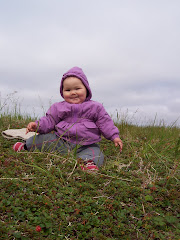
Sorry my back is to the camera, but I didn't get too many good pictures of myself dancing. Esther, on the other hand, looks great in this picture, so that makes up for it. I try to stand on the end to try to not draw attention to myself! :) As you can see in the picture that begins this post, the rest of the group looks fabulous. This is all in the new school's gym, by the way.

Wednesday, May 23, 2007

Our Winter Activities

This winter we really got into what outside and traditional activities we could enjoy. It feels like things came together for us, Esther and I, as far as what my vision of our lives could be, this winter: Esther is old enough to join in, and our new house location is really very conducive for us to have access to lots of things. I just realized that I can put a picture into this blog post itself, so check out the images attached -- or that I hope to attach when I'm done writing.

First up: My new Yellow Honda!

Here is Esther, all decked out in her cold-weather gear, sitting on my brand-new "Honda" -- all ATV's, regardless of their make or model, are casually called "Honda" in Hooper Bay. It's totally been our ticket to ride this winter, letting us go out to visit the beach, visit relatives, and explore the frozen tundra beyond the village. It's a freedom I haven't known when I have lived here before; I definitely am a bit sad to see the days of walking while pulling Esther in the sled behind me go, but we did a lot of that, and now we can join in with more community activities that happen outside of town, like ice-fishing, or manuking.

Yuraq -- traditional Yup'ik dancing
Many of you know how entranced I've felt about Yuraq since the first time I tried it, in Pilot Station, and I haven't ever felt like I've reached the same level of involvement since I left that village in the spring of 2000. It was such a great experience that led to so much understanding of Yup'ik people and village life, and brought me so much acceptance that I have been eager to try again, here in Hooper Bay. This year I set it as my goal to participate in one of the two local dance groups, and I wanted to bring Esther with me, to have her growing up around this strong tradtion. We joined the school group and danced often with them, and Esther tried her little baby best and was precious. In this picture she is holding dance fans and wearing a qaspeq, often spelled kuspuk. This type of dancing is done by waving fans or your hands in motions that tell a story, while bouncing in one place. There are both women and men dancers, though women often dance standing up and men often dance kneeling down (though there are no strict gender roles). Mostly men sing and drum the songs, and the words of the songs tell the stories that the dancers tell with their motions. The songs are repeated several times, each time getting more lively and fast, with the dancers dancing more animated each time. It's totally a thrill-- quite a rush to dance in front of an audience. And I've felt wonderful acceptance from the dance group, and I feel honored and priviledged that they allow me to dance with them.

Tuesday, May 22, 2007

Christmas 2006

Taking a Christmas Eve walk, Mom takes a turn pulling Esther and our Christmas Bread-gifts in the sled.


I know it's far in the past, but I still think a recounting of our Hooper Bay Christmas is in order.

Over Christmas my mom came to Hooper Bay to visit. She flew in on a morning bush flight a few days before Christmas, and it was lucky she was scheduled in the morning, because a swirling snowy groundstorm rose up just as she was arriving, and no other planes came in that day. It's such a typical experience to be weather-delayed, so typical that it's amazing to actually make it into the village without a delay, and so we were so grateful to begin our visit right as scheduled.

We had a fairytale snowy Christmas, and even if we were still in my old trailer under wierd water conditions, we made it really great. I was really glad to have a change of scenery from the Koskey family farm, because, though Christmas there is really idyllic, it would have brought so many memories from last Christmas when we lost my dad. Although we thought of him often, it wasn't as painful as I think it would have been if we had been in Indiana. And although we didn't have a tree, I decorated the living room with lots of lights and colorful paper stars and snowflakes, and we sewed and embroidered stockings for each of us and all of Esther's close-by Alaskan cousins. It felt very festive -- especially when Santa came and piled up the presents!

Speaking of Santa, Esther was at a perfect age for Santa this year. She was so into talking about him, wondering about him, and planning for him. We set out cookies and carrots for Santa and the reindeer before bed. Esther had pictures of reindeer on her pjs, and she decided to feed the reindeer on her shirt some of the carrots we had set out:


She went right to sleep when I told her that Santa would come only if she was sleeping. However, an hour or so later when I was getting all the presents out of their hiding places and setting them out, I shut a door too hard and it woke her up. Mom, who had already gone to bed and was in the room with Esther, said Esther sat up from sleep like a shot and shouted, "Santa!" It was all we could do to convince her to go back to sleep until morning.

And once she did wake up, she was amazed and so happy to see everything. She loved opening presents and was excited by each one, sent from near and far -- everyone was so generous and sent her so many nice things.


I cooked a turkey that day and had several of Esther's cousins and aunts over for a full dinner, and everything was just perfect. Here are Jasmine, Esther, Avery, and Alex -- Jasmine and Avery are her cousins and Alex is her uncle, Roy's youngest brother.

Our Christmas tale is not complete, however, without the recounting of the PUPPY. We adopted a puppy, Odin Jade, from the family of one of my students right before Christmas. I was not aware of how much work puppies are! And my memories of Christmas are fraught with time spent trying to get him to pee outside. We decided to call him Odin Jade because we couldn't decide between the names, and Esther says it so cute. He has grown into a good dog, and we finally did get him potty trained pretty well. He has a fondness for eating yucky stuff and puking it back up in the house, though, which is totally sick and reduces my fondness for him. But,anyway, as his story started around Christmastime, I wanted to include him in our story.

Esther holding Odin Jade the day we got him.

Jasmine pushing puppy Odin in the doll stroller.

Big Guy: Odin Jade in early May -- he's such a quirky dog, always crossing his legs!

Sunday, April 1, 2007

Old School/New School Drama

"Salt the fries"? Yuck! I rest my case about school food nutrition.... :)

So instead of trying to do a chronological log, I think I'll try to do posts by topic, and that way it might be less confusing for all of us.

So probably most of you who know me have some burning questions about the resolution of things after the burning of the school last August. Well, it's been a crazy ride, but things are mostly smoothing out now.

Students working in my old classroom -- ramshackle, but still adored and familiar.

So some backstory for folks just entering the scene: Hooper Bay School is a K-12 school, and until last August, it was a meandering complex of old and new construction, mostly falling apart but still ours. We were actually slated to have a new school this year anyway, and construction on our new school was started a couple years ago.

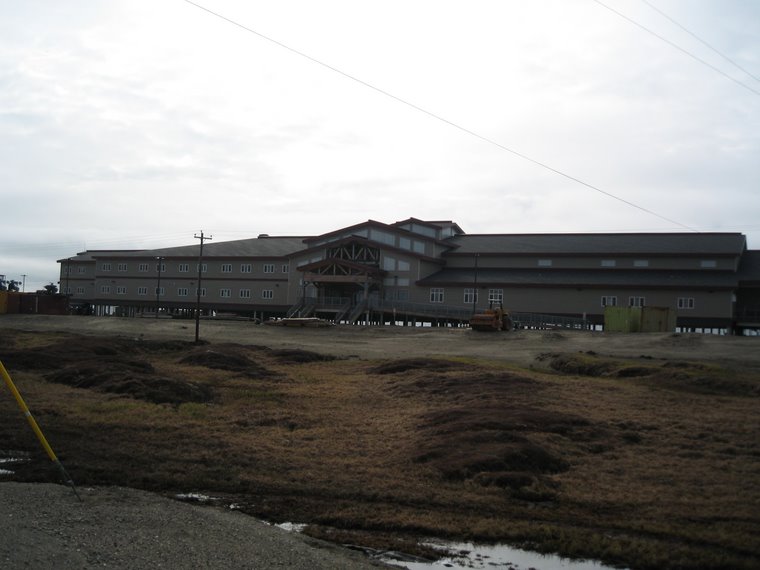
Skeleton of the new school under construction -- October 2005


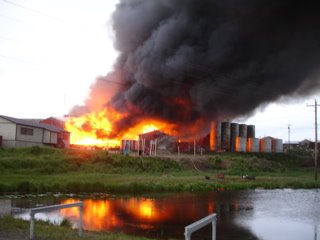
But the new school wasn't going to be done until winter, and August 3 around 6:am the school caught on fire (officially from kids playing with matches). It was an immense, insane fire that spread through the building within seconds. There were actually a team of archeologists sleeping in the school at the time, having been doing some excavation around the village, and they were lucky to get out with their lives, all of their recently-dug up artifacts torched.


The Elementary school in an inferno, and the view from across town.

The fire spread to the houses near to the school, including teacher housing and villagers' homes; one of the town stores burned, too. It was catastrophic, and the governor declared a disaster. In a wierd twist of fate for me, personally, my house was not burned (hoorah!) but I had packed up all of the things I considered valuable, both sentimentally and monetarily, and put them in a locked cabinet in my classroom. So, while my house was Ok and I am very thankful, all of my valuable things were lost in the fire. I was compensated by FEMA for certain of those valuable things, but of course not everything was eligible. The view of the destroyed school from the living room window of my old house -- yeah, it was that close.

Our school district did not compensate us for everything we lost, but we got to put in new orders and they paid us as usual during the fall while we were not in session. I guess it was nice to have a couple months off work to be with my mom, and I did visit friends in North Carolina, Pennsylvania, Seattle, and California (some who hadn't even yet met Esther!), but honestly, it was discombobulating. It felt like things were off-balance, off-kilter, almost the entire time I was out. When I got back to Hooper Bay in November, then things started to feel normal. But then more adventures were waiting.

When we arrived, none of the new housing/school was ready or open for any of us to even be in. We had six houses that had escaped the fire at the old site, and since we had been ordered back to work on November 27, by god we had to be there and cram into the old housing. For three weeks I had two roomates, and they are great folks, so it wasn't as bad as it sounds, but still, it was a little hairy. We had no water hookup for our houses after the fire, so they put up a pump house (right smack in front of the only window I had left in the trailer) that would pump water to all the remaining houses if someone would go get water in a big tank in the back of a truck several times a day and pump that water into the pump house tank. Of course, nothing can ever be easy.
The water guy filling up our pump station tank,right outside my trailer window,Dec 2006
We finally were allowed into the new school, under pressure to start school as soon as possible, and lacking students or supplies or even furniture, for that matter, we were put to work hauling boxes and boxes and boxes for a week -- all the stuff that had been ordered to replace what we lost.
Our first days back to work: hauling hallways full of boxes. As soon as we would clear them away, it would fill back up again.


My new classroom as it was about a week before we had students in school.


It was a little crazy. Then once we actually got into our classrooms, we started realizing how absolutely awesome our new building is: tons of technology, from projectors on the cieling that plug into our computers to "audio-enhancement", in which I can wear a wireless mike around my neck and my voice is projected to speakers around the room -- not having to raise my voice is worth a million bucks. Of course, there was no time and no one to train us on any of our new technology or other features of our classrooms, and not everyone's worked. There were also no locks, not anywhere in the school. So much for security! But things started coming together.

We finally started school with students on December 11.


The first day of school in our new classroom, with my 6th grade homeroom students.


After all that wildness, I finally got a great surprise: I actually had a great group of 6th & 7th graders for my reading & writing classes, and I found teaching infinitely easier than it had been the previous three years I'd taught. Amazing! Magic! One good, great thing to come out of all this year's trials. I finally understood what had drawn me to teaching; it's not something I dread waking up to, anymore.

However, this was not the end of the elemental insanity. We had fire, right, and so now the powers that be deemed that we needed to balance things out with water. On New Year's Eve early morning, a huge water main burst in the second floor of the school and pumped a deluge of water into our new classrooms, decimating several of them, several of the new teachers' new classrooms, all books, computers, files, everything lost. Deja Vu. I escaped this one, too, and am very thankful for that, but feel very badly for those teachers whose classrooms were leveled. So we were out of work for another week at that point.

Teacher housing was yet to come. None of it was finished until after Christmas, and even those houses done didn't have running water until early to mid-January. I ended up moving over right after Christmas to a new house I had to use a honey-bucket in. But the house is nice, fancy, new -- a two-story, narrow house with three bedrooms and a bathroom upstairs.
This is my housing unit -- four houses inside this one. My porch is the far one from this vantage point, and my house is the middle right one. The school is very close -- maybe a hundred yards off to the right of where I'm standing in this picture (though I'm not a good judge of distance, but it's close. I can leave home at 8:27 am if I need to be at work at 8:30 am. Yes! One of the perks of rural Alaskan life: No commute!).


Although I would just as soon live in a rudimentary log cabin or (even better) a modernized sod house, I do feel lucky to have such fancy digs. Even though it's incongruous with the landscape and the lifestyle of the village and tundra, it certainly is more convenient and easier to live in a place like this, especially since, as I'm trying to be a career mom, I don't have so much time to do the subsistence things that would be necessary in a house that fit this landscape better. And it is certainly fancy by village standards, (heck, even by last year's teacher housing standards!)and most visitors I have are slightly amazed by the size and newness of the place. So I have no complaints.

The kitchen (very important to me!) is nice and big with lots of cabinet space. It even has a dishwasher, a luxury I thought I would never know in my adult life, and something I thought was way beyond bush Alaska! The living room is large enough for a big dining table, and though there's only one window in the downstairs, it lets in a lot of light, since it's a southern-ish exposure. I got water on January 10, and I got my phone hooked up on the 12th. It started to feel for real, and now that I'm 95% unpacked, it feels like a home.


Esther hangin' with her bananna in our new fancy kitchen.


Esther tickling Odin's belly in the living room of our new house.


Esther and her close cousin Sheila, playing on our sunny living room couch.
Related Posts with Thumbnails